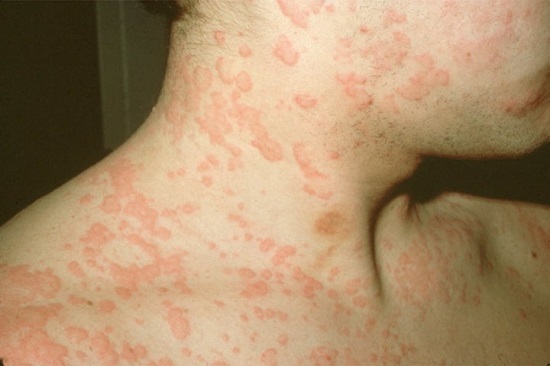
Cold Allergy
 Allergy to cold is a manifestation of various allergic reactions that occur under the influence of low temperatures. This pathological condition is more often observed in women, and usually the first manifestations fall within the age interval from twenty to thirty years. Allergy to cold in a child is rare. Symptoms of cold allergy can develop on the street in the cold season, in case of contact with cold water( washing dishes, swimming in a pond), with cold food and drinks and in a strong cold wind.
As it is paradoxical, but many people susceptible to these allergic manifestations, even the morning coolness can cause such unpleasant manifestations as lacrimation, redness of the eyelids, itching, runny nose and skin rash.
Official medicine recently recognized the existence of such a disease as an allergy to cold. People suffering from this disease have difficulty breathing at low temperatures, they have reddening of the skin, they begin to cough. However, frost is not the only cause of suffering for people who are prone to this kind of allergic reaction of the body. Such people react very sharply to cold water, drafts, transitions from warm to cold places and vice versa, dampness. Even on a hot summer day, if such a person sits on a bench with the shade of trees, he may develop symptoms of an allergy to cold. On a daily life, this condition imposes a lot of restrictions, such people need medicines almost all the time.
Cold allergy - causes
Cold allergy develops due to a violation of human immune defense. This type of allergy can develop as a consequence of the occurrence in the body of various debilitating diseases, which change the process of metabolism and affect the whole body as a whole. Such diseases include endocrine diseases( Graves' disease, etc.), hemoblastosis( blood cancer), systemic lupus erythematosus, etc. In some cases, even such common chronic diseases as sinusitis, chronic cholecystitis, intestinal dysbiosis and caries can become a catalyst for the development of allergiesTo the cold. Provocative for the development of cold allergy may be some infectious diseases - mycoplasmal pneumonia, mumps, infectious mononucleosis, rubella, measles
Cold allergy - symptoms
Symptoms and symptoms of an allergic reaction to low temperatures can be different. The most common common form of allergy, which manifests itself within a few minutes from the moment of exposure to a low temperature and is expressed in the appearance of a rash in areas that are directly in contact with the cold. Most often there is an allergy to cold on the hands and on the face. Sometimes the rash is also manifested on the lips, when a person by forgetfulness has drunk a cold drink forbidden to him.
Allergic rashes whitish or pink for color and itchy. Usually these manifestations take place within a few hours. If the body reacts to the cold itself, but to the cold wind, the rashes are usually accompanied not by itching, but by burning. Sometimes the allergic reaction is so severe that after the disappearance of allergic manifestations in the form of a rash, bruises( hematomas) remain in their place. Sometimes hypotension( low blood pressure) and headache join external manifestations of allergy to cold. Also, due to malnutrition of skin areas that have been exposed to cold exposure, it is possible to develop cold dermatitis, which manifests as flaky and itchy burgundy-red spots.
Below we will consider the most common allergic reactions to cold:
• Difficulty breathing. This symptom arises from the development of the bronchospastic reflex, as a result of which the airways sharply narrow. In case of acute reaction to the cold, one can speak of hyperreactivity of the bronchi and a predisposition to such a serious disease as bronchial asthma
• Hives. This manifestation is characterized by reddened skin, which itches and becomes blistered. Urticaria can develop in the case of contact with cold water or air, but the worst for a person when it's cold and damp at the same time. Most often, rashes occur on the inner side of the popliteal region and thighs, on the feet, hands and skin of the face. To get rid of these manifestations, it is best to go to a dry warm place as quickly as possible, drink something hot, put on warm dry clothes and take an antihistamine. Totally to save from allergic displays warm clothes can not, however considerably will weaken their display. It should be noted that synthetic and woolen things can provoke an allergy, so you should choose an outer garment made from linen or cotton cloth 
• Migraine. During the cold, many people have a headache and jaws freeze, this cold migraine. If this symptomatology is ignored, the development of such a serious disease as trigeminal neuralgia
is possible. • Runny nose or pseudoallergic rhinitis. This condition develops under the influence of cold air. It can be saved from it, burying special drops before going out on the cold, but it should not be abused, as the mucous
suffers quite severely. • Radiculitis. This disease develops in the case of inflammation of the roots of the spinal cord, which can develop under the influence of the immune complexes that form in the cold. In order to prevent this, you should warmly dress, and in the case of the already experienced hypothermia, you should warm up with the help of hot tea and take a warm bath in the shortest possible time. It is recommended to pound the loin of warming ointment
• Pseudoallergic conjunctivitis. This condition is characterized by lacrimation, redness of the eyes and itching, which in the case of a person falling into a warm place almost immediately disappear. In the case of periodic development of such symptoms, contact lenses and make-up for the eyes before going out to the cold, it is not recommended to use, as this may provoke the development of already present conjunctivitis
. The most informative method for diagnosing a person with cold allergy is a test with a piece of ice, Which a small piece of ice is applied to the skin for fifteen minutes. In case if there is an itch, reddening and / or blisters after the skin, the test is considered positive. It should be known that in the case of family cold urticaria, this test also gives a positive result, but the characteristic manifestations appear only after a few hours.
Cold Allergy Treatment
Unfortunately, there is no specific effective treatment for cold allergy. All existing medicines remove exclusively manifested symptoms, and the disease itself can not be cured. In addition, the vast majority of antihistamines have many side effects( kidneys, liver, metabolic processes, nervous system) and that perhaps the most unpleasant thing is that they get very addictive. However, if you still can not do without them, then they should be taken in minimum doses. Before going out, taking antihistamines( Telfast, etc.) will prevent allergy symptoms to cold.
Often the cold allergy is not an independent disease but a symptom of some other serious pathology, therefore, in case of this allergic reaction, to identify the immune system that exhausts the immune system, it should be carefully examined. If you are allergic to cold, contact with any possible allergens should be avoided whenever possible.
Some people mistakenly think that a good preventive remedy for this kind of allergy is the use before entering the street of strong spirits. This is a serious and dangerous delusion! In fact, alcoholic drinks not only do not have a beneficial effect with cold allergy, but also contribute to the aggravation of the process.