
Hirsutism
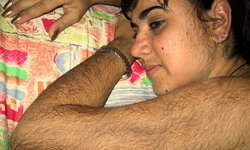 Hirsutism is a purely female endocrine disease, manifested by excessive growth of hair on the face and / or body in the androgenic( male) type. There is such a hairiness usually on the abdomen, back, in the region of the chest, chin and upper lip. With hirsutism, the menstrual cycle is often disrupted, uterine bleeding, anemia and infertility are observed. According to long-term observations it was found that 7% of women have hirsutism to some extent and sometimes it can be so pronounced that a woman needs to use different mechanical methods to remove excess hair.
hirsutism women - not just cosmetic problem, because the presence of excessive hair growth indicates the presence of the female body some fairly serious pathological processes which require a corresponding correction by the endocrinologist and gynecologist. With hirsutism in androgen-dependent zones( hips, back, abdomen, chest, face, area around the areola of the nipple), pigmented coarse hair shafts grow. It is specifically attached to certain areas of increased hair flow allows you to differentiate hirsutism with hypertrichosis, in which excess hair growth is observed in androgen-independent zones.
Hirsutism - Causes
Due to the impact of a number of certain factors, non-pigmented thin soft vellus hair, transformed into a pigmented, hard and long. The main causes of hirsutism include an idiopathic excess of androgens, side effects of drugs, a hereditary factor and hyperandrogenism.
Hyperandrogenism, or as it is called - increased production of androgens, develops under the following conditions:
- Upset pituitary function in acromegaly, prolactinomas syndrome, Cushing's and so on. The development of hirsutism pituitary origin is caused by a primary lesion of the pituitary with subsequent involvement in passing the disease processAdrenal glands, characterized by increased secretion of androgens and cortisol
- Disorders of adrenal function in adrenal tumorsThe development of hirsutism of the adrenal genesis is due to the increased production of steroid hormones( androgens including) by the adrenal glands
- Disorders of ovarian function in hypothalamic amenorrhea, ovarian hypertrophy, ovarian neoplasms( malignant and / or benign), Chronic anovulation, a syndrome of polycystic ovaries, etc. The development of hirsutism of ovarian origin is characterized by hypertrophy of the ovaries,menstrual irregularities and infertility often
genetic( family) hirsutism develops as a result of chromosomal and genetic characteristics, which are observed in certain ethnic groups or families over the past few generations. Somewhat more often hirsutism is observed in women of Mediterranean and Caucasian nationalities, less often in Asian and Northern European countries.
To develop hirsutism may cause side effects of such drugs as corticosteroids( cortisol, hydrocortisone, and so forth.), Progestins, anabolic drugs, androgens, acetazolamide, streptomycin, cyclosporin, interferon, karbomazepin, minoxidil, diazoxide, and so forth.
If hirsutism developsReasons that can not be determined, they give him the name - idiopathic syndrome of excess androgens. With this form of hirsutism, there is an increased sensitivity to androgens of hair follicles and skin receptors. The symptomatology of idiopathic hirsutism is less pronounced, the reproductive function and the hormonal cycle are usually not violated, hormonal abnormalities are negligible.
Also to the reasons for the development of hirsutism include the age and physiological conditions of the female body, under which a shift in the ratio of androgens and estrogens( postmenopause, pregnancy, etc.).In about 90% of cases, the development of hirsutism is caused by idiopathic syndrome or polycystic ovary syndrome.
Hirsutism -
main manifestation of the symptoms of hirsutism in women - male pattern hair distribution, in other words, the growth of pigmented short coarse hair on the buttocks, inner thighs, abdomen, back, around the areola breast, chest and face.
Due to the increase in androgen levels, women suffer from alopecia, increased greasiness of the hair and skin, acne. Often, hirsutism accompanies certain disorders of menstrual function( amenorrhea, irregular menstruation) and infertility.
As further course of hirsutism due to hyperandrogenism in women may experience signs of virilization( gain masculine traits): breasts reduced in size, sex drive increases, the temples appear receding hairline, voice coarsens, muscle mass increases, the fat deposits on the body are located on manType. Female genital organs also undergo some changes: the formation of vaginal lubrication stops, the labia decreases, the clitoris increases.
Hirsutism - Treatment
If there is mild hirsutism, in which there are no violations of menstrual function, a special treatment is usually not performed.
Because usually hirsutism is not a separate disease, and performs display of any present in women pathology treatment strategy aimed at eliminating the primary, provoking the development of hirsutism factor( treatment of diseases such as acromegaly, hypothyroidism, Cushing's syndrome; removalOvarian tumors, pituitary gland or adrenal glands, cancellation of hair growth-inducing medications).
Drug therapy for hirsutism is prescribed only after excluding the presence of androgen-secreting tumors in a woman. Becausehirsutism usually develops as a result of hyperandrogenism, are proven medications antiandronennogo actions that reduce the sensitivity of hair follicles to androgens and suppress testosterone levels.
In diagnosed congenital adrenal hyperplasia, dexamethasone, prednisolone or cortisol is usually used. When polycystic ovaries, in order to suppress excessive androgen production is shown receiving such drugs like clomiphene, aldalakton and oral contraceptives( Diana-35, Janine, etc.).The usual cycle of treatment with hormonal drugs is from 3 to 6 months, and sometimes these cycles are carried out repeatedly at short intervals. In pregnancy, treatment with anti-androgens is best not done, becauseThese medications have rather serious contraindications.
If hirsutism accompanies obesity, women are recommended a diet low in carbohydrates. In order to make unwanted hair less noticeable, or to remove them and help the different cosmetic treatments for hirsutism( hair removal, shaving, plucking, bleaching and so on.).If the manifestations of hirsutism are negligible, excess hair is well masked by their discoloration with hydrogen peroxide. Despite a rather wide range of cosmetology services, laser epilation and photoepilation have proved to be the most effective in combating increased hairiness.
Treatment of hirsutism lasts long enough and the first effect of reducing hair growth usually becomes apparent only after five to ten months from the start of treatment. In this case, it should be taken into account that in the case of the effectiveness of treatment, only the growth of new hair is suspended, but the already existing ones do not disappear anywhere.
Most women suffering from hirsutism likely to develop serious psychological complexes that significantly impede their communication in society and hinder full intimate and family life.
• Basold's disease • Thyrotoxicosis