Pericarditis: symptoms and treatment in adults
Pericarditis is a disease of inflammatory etiology that occurs in the pericardium, which is infectious, post-infarction or rheumatic etiology. The disease is also called armored heart.
With this disease, exudate (fluid) is collected in the pericardium, which can contribute to the transition of the disease into a chronic form. As a result, there is heart failure.
So, let's figure out what the pericardium is.
The pericardium is a pericardial sac, consisting of connective tissue, in which the heart and blood vessels are located. In childhood, it has the shape of a circle, and in adults it is similar to a cone.
According to the norm, the pericardium can contain about 30 ml liquid, which helps to reduce friction.
Content
- Causes of occurrence
- Provoking factors for the development of pericarditis
- Pericarditis symptoms
- Types and stages of the disease
- Diagnostics
- Pericarditis treatment
- Drug treatment
- Surgical treatments
- Traditional methods of treatment
- Complications
- Prophylaxis
- Forecast
- Related Videos
Causes of occurrence
The causes of pericarditis are divided into infectious and aseptic. Frequently encountered include rheumatism and tuberculosis. With rheumatism, not only the pericardium is affected.
Pericarditis caused by these diseases is infectious or allergic in nature.
In tuberculosis, the infection enters the pericardium through the lymph from the lungs.
Also, fluid in the pericardium accumulates when:
- with the penetration of microbes, viruses, fungi;
- heart attack;
- high cholesterol, hormonal disruptions;
- all kinds of trauma in the heart area;
- tumors and neoplasms of a different nature, located directly on or near the heart.
Provoking factors for the development of pericarditis

Factors contributing to an increased risk of disease include:
- infections of various etiologies (viral and bacterial). Quite often, the inflammatory process penetrates from organs nearby to the heart;
- all kinds of allergic reactions;
- lupus erythematosus, rheumatism, rheumatoid arthritis;
- heart disease;
- various injuries and injuries in the heart area;
- malignant neoplasms;
- changes in metabolic processes;
- pathological structure of the pericardium;
- general edema and hemodynamic changes.
Pericarditis symptoms

In the acute form, there is pain in the chest space or in the left side of the chest. But there are cases when the patient characterizes the pain as dull and aching.
With this course of the disease, pain often radiates to the neck or back. Quite often, the pain syndrome becomes stronger with a cough, a deep breath, and in a horizontal position.
These symptoms are similar to myocardial infarction, which is difficult to diagnose.
For the chronic form, prolonged inflammation is characteristic, due to which the pericardial sac fills with fluid.
Pericarditis in this form of the course of the disease has a number of symptoms, including not only pain in the thoracic region.
These include:
- shortness of breath when bending back;
- heart palpitations;
- increased body temperature for a long time;
- tiredness, tiredness;
- cough;
- swelling of the abdomen and legs;
- increased sweating at night;
- weight loss.
Read also:Atrial fibrillation: what is it, causes, symptoms and how to treat it?
Types and stages of the disease
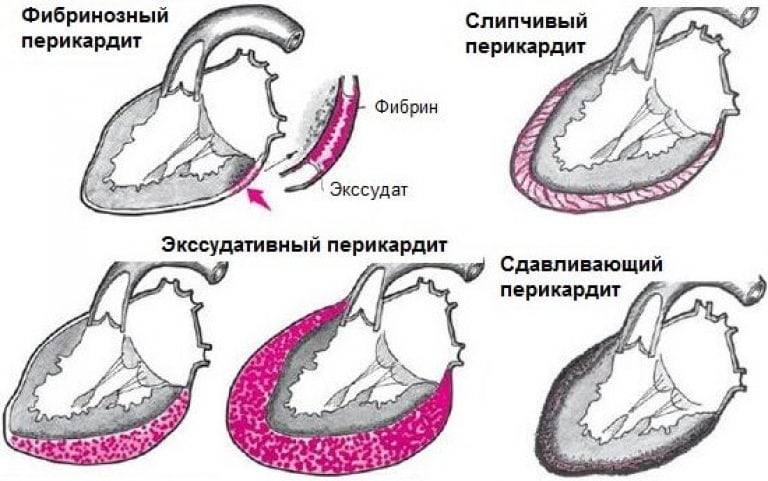
The armored heart develops for different reasons and has a different classification. By the type of the course of the disease, 2 stages are distinguished:
- acute - the disease lasts no more than 2 months;
- chronic - the disease lasts up to six months.
The stages also have a separate classification.
In the acute stage, pericarditis is divided into:
- dry or fibrinous pericarditis is characterized by a small volume of fluid in the pericardium;
- exudative or exudative is characterized by the release and accumulation of fluid of varying consistency in the pericardial sac. The effusion exudate is subdivided into:
- serous-fibrous pericarditis (mixture of liquid with thick, in small quantities can be absorbed);
- hemorrhagic (exudate consisting of blood), occurs with tuberculous inflammation:
- with tamponade (with a strong increase in the amount of fluid, serious violations of the heart may occur);
- without tamponade:
- purulent pericarditis.
The armored heart in the chronic stage has the following classification:
- effusion or exudative;
- adhesive (adhesive) - diagnosed with complications of various pericarditis. As a result of the transition to a chronic form, scarring occurs on the tissues of the pericardium, the sheets of which stick together, forming adhesions at the same time:
- flowing without severe symptoms;
- with dysfunction of the heart;
- with the formation of calcium salts in the pericardial sac;
- constrictive;
- with the appearance of inflammatory granulomas:
- exudatively adhesive.
In addition, non-inflammatory pericarditis is diagnosed:
- hydropericardium - characterized by the accumulation of exudate in the pericardium due to chronic heart failure. Can be diagnosed in utero. With the help of ultrasound diagnostics, the doctor can detect hydropericardium in the fetus, which occurs due to a malformation or edema of a hemolytic nature;
- hemopericardium - characterized by the appearance of blood in the pericardial sac as a result of penetrating trauma to the heart or rupture of an aneurysm;
- chylopericardium - the presence of chylous fluid in the pericardial space;
- pneumopericardium diagnosed when there is air in the pericardium due to heart injury;
- effusion at gout and uremia.
The disease is also subdivided according to the presence of fluid and its behavior:
- dry is characterized by a decrease in the amount of fluid or its stagnation;
- fibrinous pericarditis is characterized by a slight increase in fluid, as well as an increase in the level of protein in it;
- exudative. Exudate in the heart is contained in a large volume.
Diagnostics
The first thing the doctor does when the pericardial sac has become inflamed is to listen to the patient, in this case, the patient should be in a horizontal position or bend over backward with support on elbows.
With this type of examination, the specialist hears a characteristic noise similar to the rustling of leaves or paper.
In addition, the following studies are carried out to diagnose this disease:
- ECG;
- X-rays help determine the size and shape of the heart. If the fluid is more than 250 ml, then the heart is enlarged in the picture;
- Ultrasound diagnostics allows you to determine the amount of fluid volume and violation of the structure of the pericardium;
- computed tomography can differentiate pericarditis from other diseases;
- Magnetic resonance imaging;
- blood tests.
Read also:Causes of leg swelling in women, men, what to do and how to treat swelling in the legs
Pericarditis treatment

The tactics and methods of treatment completely depend on the type of pericarditis and the underlying causes of its appearance.
For the treatment of pericarditis, both conservative therapy and surgery are used.
Very often, surgery is the only way to overcome a carapace heart.
It is very important for this disease to see a doctor in a timely manner. The first symptoms and treatment that is started immediately is a guarantee of recovery without complications.
Drug treatment
Treatment of pericarditis with medication involves reducing swelling and relieving inflammation. And also to eliminate the root causes of the disease.
The following medications are used to treat the inflamed pericardium:
- drugs aimed at eliminating pain, for example, Ibuprofen;
- Colchicine is used in the acute form of the disease to prevent recurrence of the disease, while it is also used in the chronic form of the disease.
- anti-inflammatory drugs;
- antibiotics and antifungal agents to eliminate infections that have contributed to the development of pericarditis;
- funds aimed at eliminating arrhythmias.
The patient is advised to avoid any kind of physical activity for 3 months.
Surgical treatments
If the doctor suspects the presence of cardiac tamponade during the diagnosis, then the patient must be hospitalized, where a more accurate diagnosis will be carried out.
If the diagnosis is correct, then surgical treatment is required.
- Pericardiocentesis - This is a puncture of the pericardium with a needle or catheter in order to extract the collected fluid. This procedure helps to improve the patient's condition. In addition, it allows you to determine the type of pericarditis, and in the case of an infectious one, it allows you to identify the pathogen.
The drainage can stand up to several days, which gives a good therapeutic effect. In 99% of cases, the tamponade regresses.
- Hole formation between the pericardium and the pleural cavity is used if fluid constantly accumulates in the pericardium.
The exudate from the pericardium goes there, thus reducing the pressure in the pericardium.
It can also be carried out complete removal of the pericardium. This type of surgical intervention is carried out with constant relapses of the disease, as well as with complicated forms.
Traditional methods of treatment

Treatment of pericarditis with folk remedies is possible, but only as additional methods of treatment.
With this disease, the use of any means without a doctor's prescription is dangerous to health.
ATTENTION!!! Diuretic herbs and medications can be used as adjunctive therapy, but only if if no medications are prescribed. Decoctions aimed at eliminating inflammation can only be used after treatment prescribed by a doctor, joint reception of the same funds has a detrimental effect on the heart.
For the treatment of folk remedies for pericarditis, you will need:
- 5 tbsp. spoons chopped young needles of any coniferous tree (spruce, pine), which should be poured with half a liter of boiling water. The infusion is brought to a boil and cooked over low heat for 10 minutes. Then it must be infused for 6-8 hours and filtered. Take half a glass 4-5 times a day.
Read also:CLC syndrome
This infusion has antimicrobial, diuretic, and anti-inflammatory effect.
- You need to make a collection from motherwort grass, marsh creeper, hawthorn flowers (3 parts each) and chamomile flowers in the amount of 1 part. From the resulting mixture, take 1 tbsp. spoon and pour it 1 cup boiling water. Leave for 8 hours, then strain. Apply half a glass orally 3 times a day 60 minutes after a meal.
Complications
Pericarditis often leads to serious complications if treatment is not followed in a timely manner.
With the exudative form of this disease, an acute tamponade may appear.
When constructive enough often there is a circulatory failure, the liquid squeezes the hollow and hepatic veins, atrium, due to which diastole insufficiency of the ventricles occurs, may develop false cirrhosis of the liver.
Fusion of the myocardium with nearby organs, the chest, may also occur due to the appearance of scar tissue.
Prophylaxis
There are no special measures to prevent pericarditis because there are many causes of this disease.
The most important thing that a person can do is consult a specialist when the first symptoms appear.
Timely diagnosis and treatment contributes to a quick recovery and helps to avoid serious complications.
Forecast
The prognosis of this disease depends entirely on the form of the severity of the disease. So with a mild form of armored heart, treatment may not be required, or it will only be medication.
Complex forms of pericarditis are not only difficult to treat, but can also threaten the patient's life.
With timely treatment started, the prognosis is quite good. The recovery period takes from 2 weeks to 3 months. A relapse of the disease occurs in 15 - 30% of cases. With the appearance of complications such as heart failure, hyperthermia and the accumulation of a large volume of fluid, the prognosis worsens.
The worst prognosis occurs with constrictive pericarditis. Removal of the pericardium with this diagnosis is successful only in 60% of cases.
In order to prevent undesirable consequences and complications of pericarditis, it is necessary to seek help from a cardiologist in time. It is very important not to self-medicate with pericarditis., which can only aggravate the situation.