Spasm of cerebral vessels: symptoms and treatment (drugs, tablets)
When the walls of the vessels are compressed, the amount of blood passing through the vessel decreases. This phenomenon is called spasm. Previously, only the elderly had problems from this disease. However, the pace of society has increased and even young people nowadays suffer from vasospasm in the head. Moreover, the disease is more often observed in men.
As a result of spasm, the nutrition of the brain is disrupted and the risk of developing stroke. In order to prevent this disease from developing, you need to know how it develops and what causes it. If a person does not know the symptoms, he will not be able to go to the hospital for help in time and will suffer.
Content
- The main mechanism of the disease
- Types of pathologies
- Symptoms of pathology
- Because of what the disease develops
- Development after other diseases
- Diagnosis and treatment
- Diagnosis delivery
- Medication treatment
- Physiotherapy
- Home emergency help
- Traditional methods
- Preventive measures
- Related Videos
The main mechanism of the disease
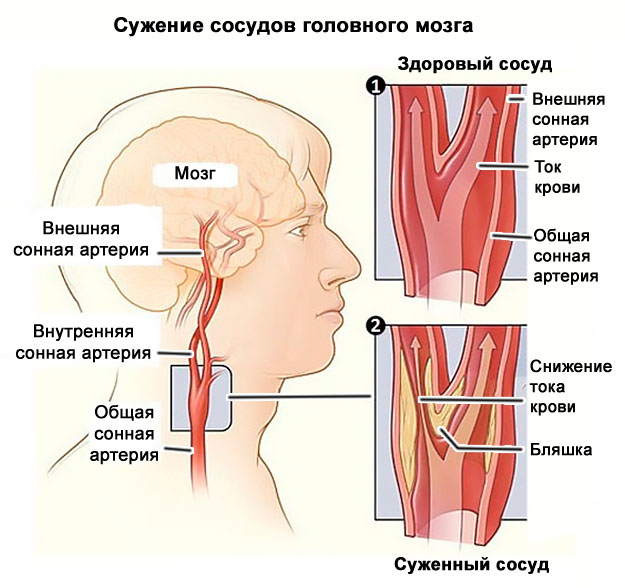
The brain is saturated with an extensive network of blood vessels that provide nutrition. A spasm is called a sharp and unexpected narrowing of the diameter of the vessels. As soon as this phenomenon occurs, then the person immediately becomes ill.
Due to insufficient supply of oxygen to the brain, the functioning of the nervous system is disrupted in humans. As a result, serious malfunctions of the whole organism can occur.
Spasm occurs not only due to problems with the vessels inside the skull, but also in the neck. It is through this area that large arteries pass, which supply blood to the vessels of the brain. If a person is engaged in work for a long time, then the quality of the blood supply to the head decreases, and this leads to a deterioration in the condition.
Note! The brain is the main human organ. It regulates all internal processes and the work of all other organs. In order for the body to work without interruption, the brain must receive fresh blood in full, delivering oxygen and nutrients to it, taking away waste. Vessels are responsible for this supply.
The movement of contraction-relaxation of the walls of blood vessels enables the blood to pass faster and in greater volume. A spasm occurs when the walls of the vessels have contracted, but not relaxed. As a result, headache occurs and blood flow is impaired.
Types of pathologies
Experts divide the manifestation of the disease according to the degree of its manifestation:
- Light form. The symptomatic picture is weak, treatment is often not required and the body recovers on its own. This form is also called angiospasm.
- Angioedema. Spasm of blood vessels in the head leads to weakness in the body and headaches. The walls of blood vessels practically do not work - they are dystrophied. Treatment is required immediately.
- Cerebro-necrotic. The patient's movements are disturbed, speech becomes slurred, he vomits, severe headaches are observed, consciousness is lost. Hospitalization in this case is required immediately.
Also, experts divide spasms into types depending on the degree of damage:
- Local character. Only a certain area of the brain is affected.
- General. Blood circulation in the brain is impaired because the blood is viscous, damage throughout the cortex.
Symptoms of pathology
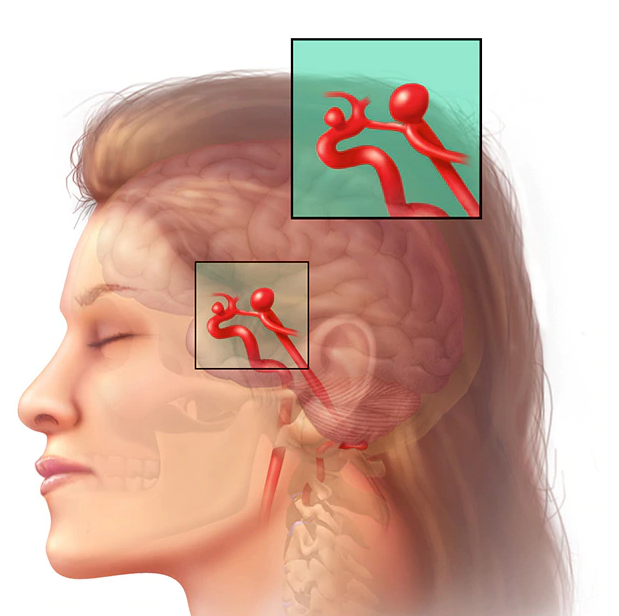
In cerebral vessels, symptoms are in small numbers and the main one is headache. In this case, pain can occur in different places. This is due to the difficulty in the passage of blood - blood does not pass through the narrowed vessels in the required amount and stagnates.
Read also:Supraventricular tachycardia
Some parts of the brain are left without food and cannot work at high productivity. Dizziness are also an integral part of the spasm. Other symptoms may also appear. In the usual case, the following symptoms appear:
- high susceptibility to fatigue;
- decreased performance;
- background noise in the ears and headwhich becomes more noticeable with physical exertion;
- vomiting and vomiting itself;
- flies before the eyes.
Symptoms of severe manifestations:
- speech defects;
- partial amnesia;
- lack of coordinated movements;
- lack of the ability to navigate in space;
- fainting.
Usually the spasm makes itself felt quickly and abruptly. In this case, the manifestation of symptoms occurs suddenly and the person does not feel anything before their onset. There is a chronic form of angiospasm. It is characterized by a mild manifestation of the symptoms described. However, in the chronic form of the disease, complications may develop.
The main complication ischemic stroke. It occurs when the vessel is completely blocked. The consequences of a stroke are extremely unpleasant - a blocked vessel leads to withering away of parts of the brain.
Since neurons in certain areas die off, a person may lose certain skills or abilities. Can stop seeing or walking or talking ...
A spasm of blood vessels in the brain can also occur in a child. It also leads to the death of certain areas of the brain. The consequence is development with a delay, as well as other pathologies:
- loss of vision or loss of vision;
- lack of hearing;
- neuropathy.
The affected child will develop migraines over time.
Because of what the disease develops
The development of spasm occurs due to difficult living conditions or, as a complication against the background of the development of other diseases. As for difficult living conditions, this includes physical exhaustion, bad habits and other factors. More about them:
- Lack of sleep. Sleep is necessary for the whole body and especially the brain for relaxation. If a person sleeps for a short amount of time or sleep is constantly interrupted, then there is a high risk of vasospasm.
- Overwork. If the human brain is loaded with work in large quantities, then it wears out faster. Therefore, he needs more frequent rest. First of all, people with intellectual complex work suffer from vasospasm against the background of overwork. People who are engaged in manual labor are much less likely to suffer from this disease.
- Oxygen starvation. The brain needs to eat well. Oxygen is the main ingredient in nutrition. With a lack of oxygen, not only a spasm is formed, but other pathologies also arise. A person needs to be in a well-ventilated room, to be outdoors more often, to have a humidifier in the room.
- Smoking and alcoholic beverages. These are bad habits, from which the activity of the brain suffers. With them, the risk of spasm increases significantly, especially with smoking, which replaces the oxygen needed by the brain.
Note! Not only difficult living conditions can lead to spasm, but also a strong emotional background. In this case, emotions can be both positive and negative. The main thing is that they will be sharp. Therefore, experts recommend that people remain calm, especially when it comes to trifles.
Development after other diseases
There are diseases that provoke the development of spasm. Among such diseases:
- malignant brain tumors;
- thyroid pathology;
- heart rhythm disorder (arrhythmia) ;
- vascular problems (venous thrombosis, thrombophlebitis);
- kidney disease;
- pathology of the cervical vertebrae.
Read also:Myocardial infarction
There are situations that can provoke a spasm. It occurs due to hypothermia of the body, excessive drinking or stress.
Diagnosis and treatment
Note! If you observe frequent headaches, as well as dizziness, you should consult a specialist. If these symptoms are left unattended, then this is fraught with the development of pathologies.
Diagnosis delivery
In order for a doctor to make an accurate diagnosis in the presence of certain symptoms, it will be necessary to conduct research:
- X-ray of the vertebrae of the neck;
- MRI of the vessels of the head.
A duplex scan will be required to establish the rate of flow of blood, detect blood clots or plaques. An MRI or CT scan, which is performed using a contrast agent, will provide a large amount of information at the cost of the patient's condition. These studies will be enough to make an accurate diagnosis and prescribe adequate and effective treatment.
It is important to find and eliminate the causes that give rise to cerebral vasospasm. If, after completing the course of treatment, after a while, the symptoms reappear, then you will have to undergo the examination again, only more in-depth.
Medication treatment
The final decision on taking medications remains with the doctor. You can not self-medicate, because it is dangerous!
If it's really bad, then at home you can urgently relieve some of the symptoms, but this does not cancel a visit to the doctor for further treatment.
The following factors influence treatment:
- age;
- stage of the disease;
- individual characteristics of a person.
Physiotherapy and vasodilator drugs are the 2 main components of treatment. If the doctor permits, then you can use the solutions of traditional medicine.
In pharmacies, pills that allow you to relieve spasms in the brain, as well as strengthen blood vessels, are sold in large quantities. The neurologist will prescribe the drug that is right for you.
Often, the following drugs are used to prevent and cure cerebral vasospasm:
- Ginkgo biloba. Its task is to improve the blood circulation in the brain. Several drugs are produced on the basis of this active substance.
- Valerian and its extracts. Allows you to relieve spasms and calm the nervous system.
- Papaverine. Accepted in case of emergency and only with a doctor's prescription. The task of the drug is to instantly expand the vessels.
- Atomax. The drug allows the vessels to maintain a normal state for a long time. This helps prevent new spasms.
- Atromide and related drugs. Required for preventive measures.
Physiotherapy
The patient will need a neck massage, because due to problems in this part of the body with blood vessels, blood may not reach the head. It is important to pay attention to this area when observing osteochondrosis. The following procedures are also suitable:
- hydro-procedures;
- oxygen treatment;
- gymnastics;
- electrophoresis using special agents.
All measures are aimed at strengthening the walls of blood vessels and improving the mobility of the neck.
Home emergency help
If the symptoms of the cerebral vessels are unbearable, and before the arrival of the ambulance you will have to wait a significant time, then it is advisable to alleviate the patient's condition. This will require:
- take a cold shower;
- place your feet in cool water;
- drink a glass of warm water with a little honey;
- do a head massage, especially in the area of \ u200b \ u200bthe temples;
- massage your knees;
- aromatherapy with soothing oils is good.
Read also:Doppler ultrasound (USDG, Doppler examination of the vessels of the head and neck)
These measures will help not only in emergency cases, but also in case of severe fatigue after strenuous work.
Traditional methods

As a preventive measure and as an accompanying procedure during the main treatment, folk remedies are perfect. As measures to eliminate spasms of the cerebral vessels, they use:
- Cold compress. For him, ice is used based on a decoction of herbs. The broth is poured into ice molds and frozen. They can also massage.
- Decoctions. Instead of drinking coffee or regular tea, it is advisable to drink a decoction. Rosehip, motherwort or yarrow are used for it. Such drinks bring blood pressure back to normal and the body's well-being as a whole improves.
- Using a product based on garlic, honey and lemon. These ingredients are taken in equal parts and ground in a mixer. The resulting product is eaten in a teaspoon a day for a whole month.
Only these measures will not work to quickly stop spasms of the cerebral vessels, especially in severe cases. But as an addition to drug treatment, they are effective. Prevention with folk remedies, especially at age, is taken for granted.
Preventive measures
In cerebral vessels, symptoms should not occur when decoctions are used in combination with other methods. To do this, you will need to comprehensively deal with your body. For this you will need:
- Proper nutrition. Porridge will be used as food in the morning. It is required to regularly eat seafood, a large amount of vegetables. Fatty dairy products should be minimized, as well as the consumption of sweets, soda should also be excluded from the diet, but drink enough liquid (2l. per day) has not been canceled. Drinking plenty of fluids helps harmful substances leave the body faster and increases blood flow.
- Athletic lifestyle. A large number of movements helps the vessels to strengthen and be always in good shape. That is why people who are engaged in physical labor are much less likely to have problems with the vessels of the brain. You can be active in any form - dancing, gymnastics, walking, cycling, fitness. The main thing is to avoid overloads, including mental ones. Stress should also be controlled.
It turns out that for preventive measures it is enough to eat right, lead an active lifestyle and worry less. Then the person will not be disturbed by the symptoms of an unpleasant nature in the vessels of the brain. Non-traditional yoga classes will help put your nerves in order if the work is intense and active.