
Atrial fibrillation: what is it, causes, symptoms, treatment, prognosis
Content
- What is atrial fibrillation?
- Causes of atrial fibrillation
- Classification
- Atrial fibrillation symptoms
- How can I check my atrial fibrillation?
- Diagnostics
- Atrial fibrillation treatment
- Antiarrhythmic drugs
- Electrical cardioversion
- Catheter ablation
- Implantation
- Anti-embolic treatment
- What can you do at home?
- Forecast
What is atrial fibrillation?
Atrial fibrillation Is a heart rhythm disorder (atrial fibrillation) in which the atria lose their ability to contract normally, instead they twitch asynchronously. This condition is also called atrial fibrillation (AF), in which only certain groups of muscle fibers contract.
The risk of atrial fibrillation increases with age. Despite the fact that both women and men are exposed to the condition, the male sex is most susceptible. Below are examples of impulse sounds.
The main danger of atrial fibrillation is the increased risk myocardial infarction, stroke and other pathologies of the cardiovascular system (the organ system that circulates blood).
At the time of atrial fibrillation, blood stagnates in the heart, blood clots (thrombi) form. When the heart rate is restored, blood clots travel throughout the body and can clog blood vessels.
Most often, blood clots provoke a violation of cerebral circulation, which leads to a stroke. When the intestinal vessels are blocked, necrosis (death) of the organ can occur, which entails life-threatening consequences.
The prevalence of pathology is higher in older age groups - for example, at the age of 60 years atrial fibrillation occurs in 6% of the population and in 8% of people over 80 years old, mainly in men, 1.7 times more often than in women.
Causes of atrial fibrillation

The cause of atrial fibrillation is considered to be structural changes in the tissues of the heart, which affect the electrical conductivity of muscle fibers.
The following factors can provoke an arrhythmic attack:
- organic pathologies of the heart, congenital defects and previous operations;
- high blood pressure or high cholesterol;
- age 60 and older;
- violation of the cardiac blood supply - oxygen starvation of tissues leads to disruption of the function of the sinus node and other vital parts of the heart;
- tumor-like formations in the heart - benign and other tumors disrupt the conduction of electrical impulses, which provokes atrial fibrillation;
- some diseases, in particular thyroid disease and diabetes, create an increased risk for the development of arrhythmias;
- bad habits - smoking and alcohol abuse; depletion of the heart muscle due to chronic alcohol poisoning - myocardial dystrophy;
- hypertension (essential hypertension);
- coronary heart disease (Ischemic heart disease), rheumatism hearts;
- electrolyte imbalance as a result of deficiency potassium and magnesium;
- obesity is also a trigger for cardiovascular disease;
- vegetative vascular dystonia (VVD).
Usually, the trigger for the onset of atrial fibrillation is completely normal loads - a hearty dinner, a cup of strong coffee or a glass of strong alcohol.
Atrial fibrillation can occur after severe psycho-emotional stress and physical exertion.
Classification
The occurrence of atrial fibrillation is associated with increased activity of some parts of the nervous system. Dysfunction of the parasympathetic link of the nervous system provokes arrhythmia of the vagal type (Vagus is the vagus nerve), while activation of the sympathetic region causes hyperadrenergic arrhythmia.
- Vagal-type arrhythmia begins after a plentiful meal, more often develops in men. The onset of an attack occurs when taking a horizontal position, due to bloating and bowel problems and other factors that cause increased intra-abdominal pressure, such as a tight belt, tie, or high collars. At the same time, psycho-emotional overexertion and exercise do not play a role in the occurrence of atrial fibrillation.
- Hyperadrenergic arrhythmia, unlike vagal arrhythmia, is more common in women. The typical time of the onset of an attack is in the morning and in the first half of the day, and the main stimulating factors are stress, mental stress, nervous strain, exercise. At rest, after taking a horizontal position, the attacks of arrhythmias usually disappear.
Read also:Syncope condition
Atrial fibrillation symptoms

The functioning of all vital organs depends on the normal functioning of the heart, and with atrial fibrillation, the blood supply to the body is disrupted. Here are the main signs and symptoms atrial fibrillation:
- muscle weakness and dizziness;
- sweating (hyperhidrosis), fast fatiguability;
- symptoms of angina pectoris (angina pectoris);
- panic attacks, fear;
- frequent urination;
- chest pain, a feeling of "sinking" of the heart;
- increased heart rate, when the heart seems to "jump out of the chest."
It should be remembered that if atrial fibrillation of the heart is not combined with tachycardia, one of its most striking manifestations, in which heart rate (Heart rate) - it can be difficult to recognize it in time. Any violation of the heart rhythm is potentially dangerous, as the heart is subjected to additional stress and blood circulation is impaired.
If an arrhythmia attack began more than 24 hours ago, and the heart rate has not recovered, immediate medical attention is needed.
How can I check my atrial fibrillation?
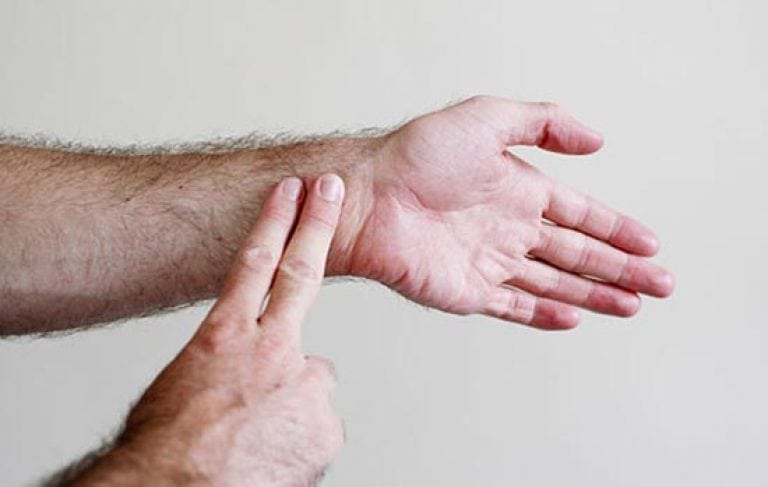
AF can be detected feeling the pulse on the wrist. If atrial fibrillation, the pulse will be irregular, the beats will be variable in strength. Also, with atrial fibrillation, you can feel missed beats or extra beats, which are very common in this condition.
In some people, atrial fibrillation can be an on-going and on-going phenomenon, so sometimes the pulse from time to time, it can beat normally, and sometimes it is irregular.
Examples of pulse sounds
Regular heart rate sound:
Irregular heartbeat sound:
Diagnostics
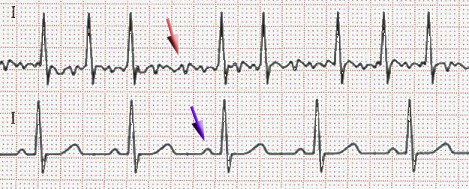
Before making a diagnosis, the cardiologist should conduct an initial examination, including pulse diagnosis, heart rate by listening through a phonendoscope and an ECG and taking an anamnesis of data (information from patient).
With atrial fibrillation, patients usually complain of irregular heartbeat, “fading” of the heart, and increased heart rate.
The main diagnostic method atrial fibrillation - electrocardiogram and Holter monitoring, during which the patient's ECG indicators are recorded during the day, while the patient is leading a normal life. For monitoring, a special apparatus is attached to the patient's belt, which records changes in the heart rate.
Usually, it takes from two days to a week to collect the necessary data, during which the patient has at least one arrhythmia attack. Based on this study, the doctor obtains the following data:
- the type of atrial fibrillation and provoking factors are determined;
- pauses and deviations of the heart rate at rest are detected;
- the duration of the attack is revealed, its nature and the area of the pathological focus - in the ventricles or atria.
Read also:Myocardial infarction
The next type of diagnostic study, magnetic resonance imaging (MRI), provides the most accurate information about the cause of the disease. MRI allows you to assess the structure of tissues and identify:
- tumor-like neoplasms that disrupt the conduction of an electrical signal;
- inflammatory processes in the myocardial tissue;
- congenital heart and valve defects;
- postoperative complications, scarring;
- blood clots and atherosclerotic formations.
X-ray examination of the chest area also allows detecting pulmonary pathologies veins, diseases of the respiratory system that cause oxygen deprivation and an increase in heart cameras.
Atrial fibrillation treatment
When determining the tactics of treatment, it is important to conduct a diagnostic examination and find the main cause of atrial fibrillation. So, if cardiac pathology has arisen against the background of systemic diseases - diabetes mellitus, thyroid dysfunction, hypertension - treatment is aimed at the cause of the arrhythmia.
In any case, the main direction of therapeutic measures is drugs, recovery sinus rhythm, prevention of atrial fibrillation in the future, maintenance of normal cardiac rhythm.
Antiarrhythmic drugs
Antiarrhythmic drugs can stop attacks of atrial fibrillation, but in the chronic form they are ineffective.
- First of all, drugs that normalize heart rate are used to treat arrhythmias. Due to the fact that tachycardia of the heart is more dangerous to the patient's life than bradycardia, the heart rate is usually reduced to normal (60 beats per minute). For this, beta-blockers and calcium antagonists are used (Atenobene, Amlodipine) .
- With a prolonged attack of arrhythmia lasting longer than 1-2 days, it is necessary to take drugs that slow down blood clotting (Warfarin), for the prevention of thrombosis.
Antiarrhythmic drugs help to restore the heart rhythm in a conservative way, making it possible to improve the condition of patients in 60-80% of cases.
Electrical cardioversion
With attacks of atrial fibrillation, which threatens the patient's life and low sensitivity to drugs, electrical cardioversion is used as a therapy.
The essence of the method is as follows: the patient is immersed in a short-term sleep for several minutes and an electric discharge is applied to him at a certain phase of the heartbeat. This method helps in almost 100% of cases and does not require long-term use of drugs.
The downside of such treatment is the complexity of the conditions for its implementation - you need special equipment and trained medical personnel.
Electrical cardioversion can only be performed on an outpatient basis, so it is often impossible to stop an attack on your own. Nevertheless, modern methods of treating atrial fibrillation use cardioverters - devices that are sewn under the patient's skin and help to normalize the heart rate as soon as it is disturbed.
Catheter ablation
Catheter ablation is a low-traumatic method of intervention, since it does not require an incision of the chest. Catheter ablation is also called destruction, since the essence of its effect is in the destruction of pathological pathways for conducting electrical impulses.
To begin with, foci of pathological pathways are detected by diagnostic methods - an electrophysiological study is performed.
During the operation, the intergrown tissue fibers, through which the signal passes, are opened. There are several types of catheter ablation, depending on the method of destruction of pathological pathways:
- Ultrasonic;
- Chemical;
- Electrodestruction;
- Laser exposure;
- Cryodestruction;
- Radio destruction.
Radiofrequency ablation - the most common method of destruction of pathological foci, since it is believed that it least of all damages the nearby myocardial tissue.
Read also:How to lower blood pressure at home, 7 quick effective ways + recipes of traditional medicine for hypertension
If catheter ablation did not help get rid of the seizures completely, then this may be the following explanations:
- there were several foci of pathology in the heart, and only one was destroyed;
- the area of damage is too large, as it happens after myocardial infarction, and it is impossible to remove it without serious consequences;
- the frequency of irradiation during cryodestruction was not enough to destroy pathological pathways.
Implantation
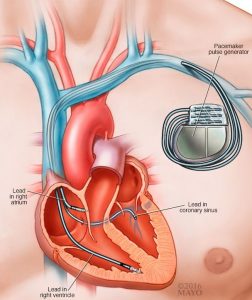
The next treatment for atrial fibrillation is implantation of a pacemaker or pacemaker. This device is sewn under the skin in the area of the heart, it emits electrical impulses that restore normal heart rhythm. The operation is less traumatic, since only the skin is cut, and the opening of the chest and damage to the ribs does not occur.
Treatment of atrial fibrillation by surgery is carried out in the chronic form of the disease, when drugs are ineffective.
The advantage of surgical methods is their high efficiency, no need for large doses of medicines. Antiarrhythmic drugs are eliminated from the body for a long time and can negatively affect vital systems in high concentrations.
Anti-embolic treatment
Another area of treatment for arrhythmia is antiembolic, using disaggregants. Since the most common and dangerous complication of atrial fibrillation is the formation of blood clots, which can clog blood vessels and cause organ necrosis and irreversible dysfunctions, it is important to carry out prevention thromboembolism. For this, the patient is prescribed blood thinning drugs - warfarin and acetylsalicylic acid.
Emergency drugs for atrial fibrillation:
- propanorm,
- cordaron,
- quinidine,
- novocainamide,
They are administered intravenously or taken in tablet form. The dosage of medications is determined based on the data of the electrocardiogram and blood pressure.
An invasive technique called radiofrequency isolation is used to restore normal heart rhythm and prevent recurrence of atrial fibrillation. It is aimed at isolating the focus of excitation in the pulmonary veins from the atria, its effectiveness is lower than that of electrical cardioversion and is about 60%.
What can you do at home?

At home, regular aspirin (Acetylsalicylic Acid) can help. In most cases, aspirin can reduce the likelihood of blood clots in your artery.
The drug can be useful at the time of atrial fibrillation, but you still need to consult a cardiologist.
Here are some supplements that can help accelerate the body's ability to detoxify, strengthen the cardiovascular system, and fight vascular congestion:
- Omega-3 unsaturated fatty acids (supplements or one tablespoon of fish oil per day, such as cod liver oil);
- Eat garlic (with a bang thins the blood);
- Coenzyme Q10 (essential heart supplement, goes well with Omega-3)
- Carotenoids;
- Selenium (a powerful antioxidant)
- Vitamins C, D and E.
Forecast
Research has shown that atrial fibrillation is associated with a higher risk of death from 1.5 to 1.9 times, which is partly due to the strong association between AF and thromboembolism (acute blockage of blood vessels thrombus).


