Conjunctivitis: symptoms (photo) and treatment in adults and children
Content
- What is conjunctivitis?
- Symptoms
- Practical remedies and advice for conjunctivitis
- Bacterial conjunctivitis
- Viral conjunctivitis
- Herpetic keratoconjunctivitis
- Allergic conjunctivitis
- Spring conjunctivitis
- Conjunctivitis caused by chemical and physical agents
- Trachoma
What is conjunctivitis?
The conjunctiva is a transparent mucous membrane, richly vascularized and innervated, that covers the inside of the eyelids and most of the front of the eyeball; therefore the conjunctiva is exposed to the external environment and is in constant contact with microorganisms, some of which live as saprophytes (without causing harm) in the conjunctival bag.
The conjunctiva has several functions:
- forms an elastic surface that facilitates skin movements of the eyeballs;
- protects lymphatic structures with antibodies;
- protects the eyes by producing a tear film.
Depending on the etiology, that is, the reasons, various forms of conjunctivitis can be distinguished:
- infectious (due to bacteria, viruses, fungi, parasites);
- allergic;
- caused by physical and chemical agents.
Conjunctivitiscaused by viruses and bacteria, is the most common formfrom which mycetes usually arise after a change in the normal bacterial flora, sometimes caused by inappropriate or excessive prolonged use of topical antibiotics; parasitic forms, rare in Russia, are often unilateral and more difficult to treat.
Allergic conjunctivitis is usually chronic and regresses at least temporarily with corticosteroid (cortisone) treatment; some viruses (adenovirus, herpes viruses) often also spread to the cornea, causing inflammation of the cornea (keratoconjunctivitis), which is manifested by pain and a possible decrease in visual acuity when exposed to the area of the optic nerve of the cornea.
Symptoms
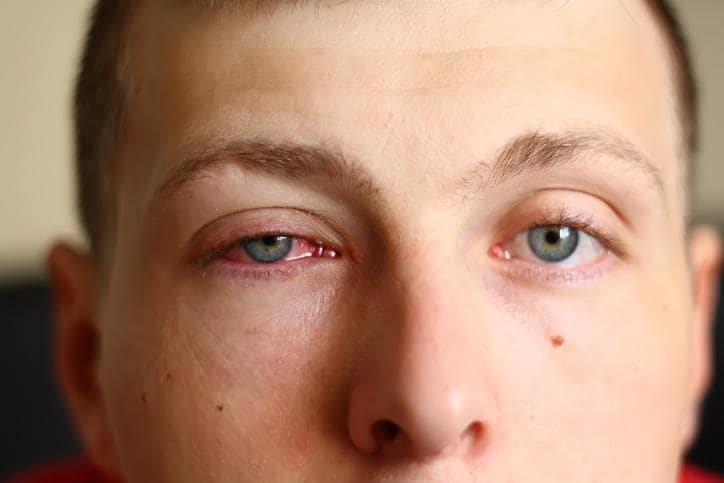
Conjunctivitis, one of the most common eye diseases, is an inflammation of the conjunctiva, the most common symptoms of which are:
- lacrimation;
- pain;
- a feeling of irritation and / or a foreign body in the eye;
- burning;
- photophobia (discomfort due to light);
- itching (typical for allergic forms);
- secretion (from serous to frankly purulent);
- swelling in the eye area;
- hyperemia (redness);
- the presence of exudate.
Practical remedies and advice for conjunctivitis
Some of the most useful home remedies include:
- Avoid using contact lenses until approved, possibly excluding those used at the time of diagnosis.
- Apply lubricating eye drops to relieve pain and discomfort.
- Gently wipe your eyes with disposable sterile eye wipes.
Recommended do not use medications (eye drops or eye ointments) that are not clearly prescribed by a doctor or pediatricianwith the exception of over-the-counter drugs, avoiding decongestants unless recommended by your doctor.
Bacterial conjunctivitis, the most common form of the disease in adults and children, is usually is self-limiting and can be treated for several days, at the same time for self-treatment usually antibiotics / cortisone are used, such as good or tobradexwhich should always be prescribed by a doctor.
In case of conjunctivitis, it is recommended:
- wash hands before and after prescribing eye drops / creams;
- use only prescribed medications;
- wash your face often, especially before using medications;
- wear sunglasses;
- Eating a healthy diet to promote recovery
- see a doctor again if there is no improvement;
- stop using eye drops and ophthalmic creams after healing.
Contraindicated:
- touching or rubbing your eyes;
- use one towel for face and hands, and share it with others;
- rubbing your eyes with clothing or other unclean fabrics;
- cover eyes with a bandage, unless directed;
- sharing medicines with others.
Bacterial conjunctivitis
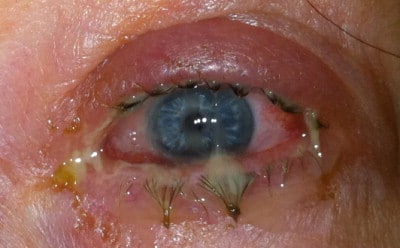
Bacterial conjunctivitis, along with viral ones, are the most common forms, even among children.
Read also:Keratitis of the eye - symptoms and treatment, photos, causes of occurrence in adults, in children
They can be acute or chronic and are characterized by
- more or less intense conjunctival hyperemia (redness of the eyes);
- sensation of a foreign body (sometimes described as “like sand in the eyes»);
- yellowish-greenish serous or purulent discharge with possible corneal involvement (see Photo).
Abundant secretion forces eyelashes stick together on awakening.
Acute forms have an incubation of about a week, they are mainly supported:
- Staphylococcus aureus;
- pneumococcus;
- meningococcus (less often).
Infection occurs both through direct contact and through vectors (flies and other insects, as described in the case of trachoma), contagiousness is high; patients with dry eye syndrome or an inability to properly close the eyelid are particularly sensitive to this, but other risk factors also include:
- a weakened immune system;
- malnutrition;
- flu and other acute and chronic diseases;
- newborns and the elderly.
Acute forms appear suddenly, sometimes with clinical signs in both eyes; the sensation of a moving foreign body causes the subject to constantly rub his eyes, causing the infection to spread from one eye to the other. Visual acuity is never impaired.
The most important complication is corneal lesion, albeit rare, which can develop in the direction of corneal ulceration.
Chronic forms are much less common than acute; as a rule, these are the outcomes of acute forms that were poorly treated or not taken into account, or that may be associated with inflammation of the eyelids (blepharitis). They often present with attenuated symptoms, but are responsible for particularly unpleasant clinical presentations for the patient.
Secretion is usually insufficient, while moderate hyperemia (redness) is conjunctival; the patient may also complain:
- burning;
- constant itching;
- and gritty or dry eyes.
Therapy for these forms is based on the use of eye drops and antibiotic ointments, three or four times a day, using eye drops throughout the day. and ointments in the evening before bedtime (the predominant use of eye drops during the day is associated with the need not to change, even temporarily, visual acuity, while as ointments, whose longer contact with the conjunctiva suggests a longer therapeutic effect, can be predominantly used before sleep).
It is important to extend the treatment for a few days to avoid relapses; do not cover the affected eye or eyes with a bandage, as the bandage on the eye, increasing the temperature inside the eyelids, promotes the incubation and reproduction of microorganisms; in addition, by preventing blinking, it becomes difficult to remove exudate rich in microbes and toxins.
Viral conjunctivitis
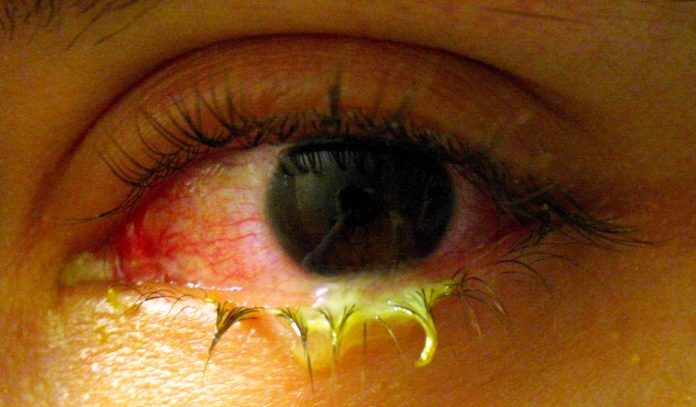
Viruses not only penetrate the conjunctival tissue (epithelium), but also often cause inflammation of the corneal epithelium, so the viral lesion is usually keratoconjunctival in nature.
However, damage to the conjunctiva or cornea may predominate (eg, in forms of herpes simplex).
Adenoviruses are the causative agents of this type of conjunctivitis; they are highly contagious forms that are transmitted with tear secretions and are almost always bilateral (with autoinoculation). In the most severe cases, pseudomembranes can be created that cause scar adhesions between the ocular and bulbar conjunctiva (simblefaron). Secrets are always serous and never purulent, sometimes they may be preceded by adenoviral conjunctivitis (pharyngo-conjunctival fever).
An important form of adenoviral conjunctivitis is the epidemic of keratoconjunctivitis caused by some types of adenovirus (strains 8 and 19). The onset is sudden, with the appearance of the following symptoms:
- edema and hyperemia of the conjunctiva;
- intense lacrimation;
- eye pain due to corneal involvement.
Read also:Pterygium
In addition, in this case, corneal damage acts as a complication, causing corneal opacity with a decrease in visual acuity and increased photophobia. Evolution is variable, as is duration; healing usually occurs in two weeks, sometimes it can take months. There are frequent cases of relapses.
Viral conjunctivitis is a particularly contagious disease that requires better attention, to avoid transmission to third parties (it is generally recommended to leave children at home from school until recovery).
However, it is usually a self-limiting infection, lasting about 1–3 weeks; cold compresses are especially helpful in relieving symptoms, but for patients with severe photophobia or with severe symptoms, a specialist (ophthalmologist) may resort to prescribing drops cortisone. Although corticosteroid therapy is usually contraindicated in viral infections, especially in hyperplastic infections due to infectious the action of cortisone, in the case of keratoconjunctivitis, the predominance of the anti-inflammatory and decongestant effect of cortisone on pro-infectious.
Herpetic keratoconjunctivitis

Herpes simplex virus is a common cause of conjunctivitis.
The first infection can occur during childbirth, in which case the newborn becomes infected from the mother, who carries a herpes infection of the genitals and genitourinary tract. It can develop into an absent-minded, even severe and sometimes fatal form. The cornea is also frequently affected.
Conjunctivitis usually lasts two to three weeks, while keratitis can last for months.
After the first infection has been overcome, the patient cannot be considered definitively cured: in fact, the virus is not destroyed by infected cells, but remains latent, without manifesting clinical signs.
Then the virus can become active due to various reasons (heat, cold, ultraviolet rays, decreased immune system, stressful situations) and cause a relapse, usually seasonal, which has an important characteristic of damage only cornea (keratitis) without touching the conjunctiva.
Even shingles (Herpes zoster) can cause conjunctivitis, with much more serious corneal lesions and serious complications in 50% of cases, affecting not only the cornea, but also other important structures of the eye:
- sclera;
- optic nerve;
- choroid.
Therapy for herpetic conjunctivitis is based on topical application broad-spectrum antibioticsto avoid bacterial superinfections, possibly by combining antiviral drugs for topical use (ophthalmic ointments).
Allergic conjunctivitis
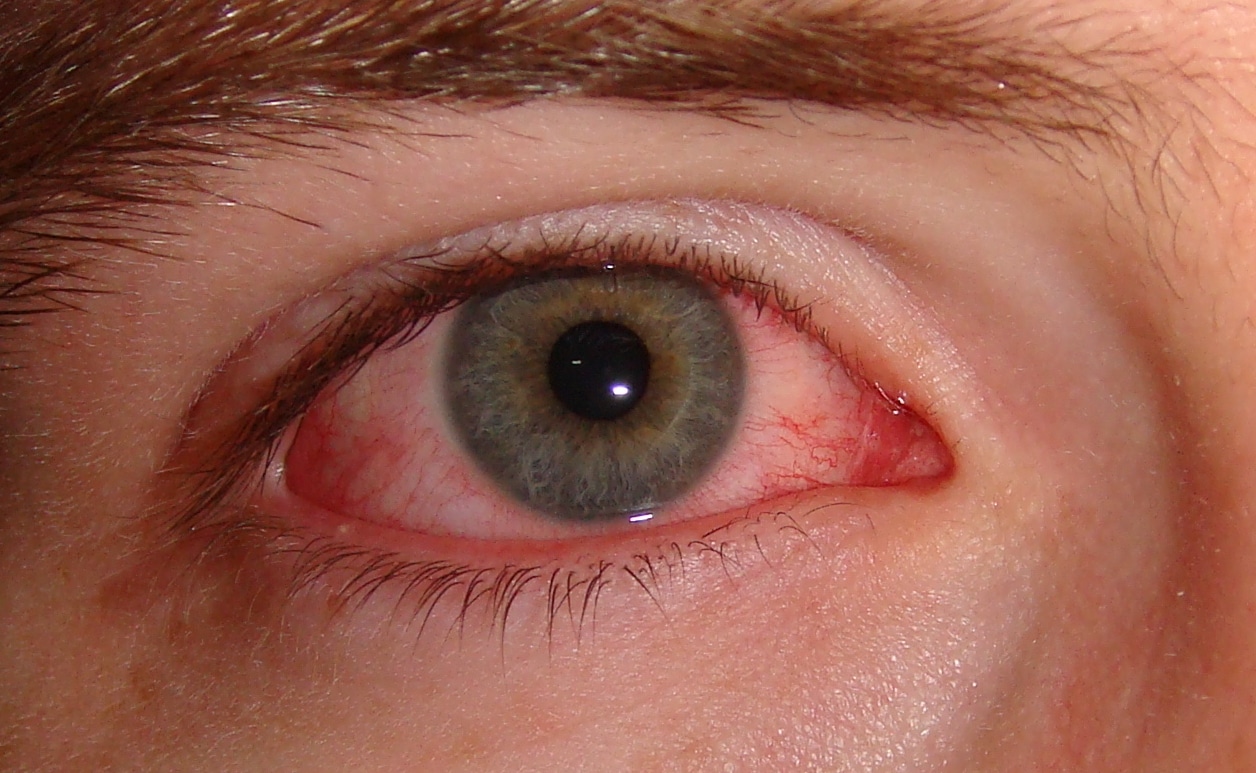
Allergic conjunctivitis is a fairly common and extremely polymorphic form of conjunctivitis.
The conjunctiva is the site of occurrence of allergic reactions, even of significant intensity, repeatedly in contact with various allergens present in the environment and due to its rich vascularization and innervation.
Attracted allergens can be airborne (eg pollen) or carried by contact (cosmetics and other irritants). Repeated bacterial infections or long-term pharmacotherapy can also cause allergic reactions in susceptible individuals. The clinical development of all these forms is usually chronic.
The most common forms:
- atopic conjunctivitis (rhinoallergic conjunctivitis),
- contact dermatoconjunctivitis (a form caused by repeated exposure to chemicals that act as allergens).
Atopic conjunctivitis is caused by several allergens, but usually pollen during the "hay fever"Or pollen season. Other allergens:
- vegetable matter;
- derivatives of epidermal animals;
- professional powders.
It can occur in a seasonal or perennial form.
The acute form is characterized by a rapid and sudden inflammatory response that occurs a few minutes after exposure to the allergic agent; it is characterized by the presence of:
- hyperemia (see. photo above);
- edema (significant swelling);
- secretion;
- severe itching, burning and photophobia.
Read also:Redness of the eyes: causes and treatment
This form usually affects both eyes and, by eliminating the allergen, the symptoms will regress.
In chronic forms, the clinical picture is less dramatic, with moderate hyperemia and secretion, even if the symptoms felt by the patient may be particularly annoying.
Optimal therapy should be aimed at eliminating the pathogen, which is often not possible, so local symptomatic therapy with antihistamines and cortisone is mainly used.
Spring conjunctivitis
It is bilateral and recurrent keratoconjunctivitis that mainly affects children and young people.
The etiology is unknown, but various characteristics suggest a possible allergic cause:
- cyclical and repetitive;
- seasonal nature;
- itching and connection with other allergic manifestations.
The immunological etiological hypothesis was also considered on the basis of constitutional hypersensitivity to harmless agents (heat, light, humidity).
The disease begins quickly:
- constant photophobia;
- severe itching, often associated with sensation foreign body in the eye;
- pain;
- profuse lacrimation.
The child often shows characteristic signs:
- he lowers his head;
- protects eyes from light;
- may feel pain that causes him to constantly rub his eyes.
The cornea is rarely affected.
Local and symptomatic treatment with eye drops. Applicable:
- decongestants;
- antihistamines;
- cortisone.
It is useful to combine these drugs with cromoglycic acid, which is especially useful for preventive purposes, before seasonal symptoms appear.
Conjunctivitis caused by chemical and physical agents
This form of the disease is caused by various irritants of the conjunctiva:
- physical, such as light, snow, X-rays and gamma rays;
- chemicals such as silver (often found in eye drops), irritating gases, soap, cigarette smoke, fertilizers, pool water not treated with chlorine.
The most common symptoms include clinical variables characterized by:
- hyperemia;
- photophobia;
- lacrimation;
- burning sensation;
- tingling sensation and foreign body.
Treatment is primarily prophylactic, avoiding exposure to the pathogen; It may be helpful, especially when in contact with chemical agents, to flush the eyes with saline to remove the substance and then drops of antibiotic and / or cortisone.
Trachoma
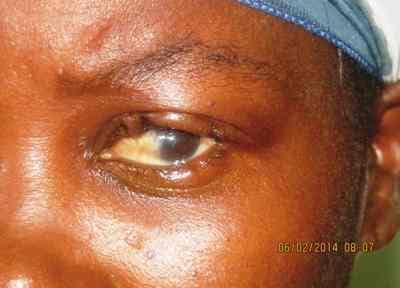
Trachoma is a chronic inflammation of the conjunctiva and cornea (keratoconjunctivitis) characterized by the formation of nodules that make the surface of the eye rough and grainy (also called granular conjunctivitis). The initial symptoms are typical of keratoconjunctivitis with chronic discharge of purulent mucus.
It occurs as a result of infection with the bacterium Chlamydia Trachomatis, also responsible for chlamydia (venereal disease).
Infection occurs through direct contact through inoculation of genital secretions into the eyes; the bacterium determines its pathogenic effect by producing a toxin that causes inflammation, destruction of the conjunctiva and corneal tissue, which leads to possible complications such as corneal ulcers and extensive scarring up to blindness. Another possible complication is represented by changes in the shape of the eyelids due to healing processes.
The evolution of the disease is extremely slow, and only with early diagnosis and proper treatment can it be cured within a few months without complications.
Treatment includes preventive measures for hygiene, disinfection and isolation of patients, as the disease usually develops in difficult environmental conditions and pollution.
The therapeutic choice involves the use of certain antibiotics (tetracyclines) given several times a day for several weeks, sometimes even months. Treatment of complications is often surgical, up to corneal transplant for healing.