
Sjogren's syndrome: what is it, symptoms, treatment, prognosis
Content
- General information about the disease
- Signs and symptoms of Sjogren's syndrome
- Causes and risk factors
- Possible risk factors
- The importance of the exocrine glands
- Affected populations
- Diagnostics
- Treatment for Sjogren's syndrome
- Dry eye treatment
- Dry mouth treatment
- Drug treatment
- Treating other symptoms of Sjogren's syndrome
- Forecast
General information about the disease
Sjogren's syndrome is a disorder of the immune system (the body's defense system against infection). White blood cells (red blood cells) attack the lacrimal and salivary glands, which reduces the amount of saliva and tears produced by the patient. This causes dry mouth and eyes and other accompanying symptoms.
In women (who are most commonly affected), the glands responsible for vaginal moisture are also affected, resulting in vaginal dryness.
Sjogren's syndrome is an autoimmune disease.
The immune system usually helps protect the body from infection and disease by creating cells called antibodies. Antibodies attack bacteria and viruses, helping to prevent disease.
An autoimmune disorder causes the immune system to malfunction. Instead of attacking foreign cells, such as bacteria, antibodies begin to attack healthy cells and tissues in the body.
In the case of Sjogren's syndrome, the lacrimal and salivary glands are attacked.
Other autoimmune diseases include:
- rheumatoid arthritis (leads to pain and swelling of the joints);
- lupus (leads to joint pain, fatigue, and skin rash);
- Hughes-Stovin syndrome (when proteins and fats in the blood are attacked by the immune system, leading to the formation of blood clots).
The disease is classified as:
- primary Sjogren's syndromewhen the condition develops on its own, and not as a result of another disease;
- secondary Sjogren's syndromewhen the condition develops in conjunction with another autoimmune disorder, such as lupus erythematosus or rheumatoid arthritis.
The cause of Sjogren's syndrome remains unknown, but scientists speculate that the condition is caused by a combination of genetic, environmental, and possibly hormonal factors.
There is no cure for the disease, but there are a number of methods to help control symptoms and signs. These include eye drops and medications to stimulate saliva production.
Complications of Sjogren's syndrome include tooth decay, non-Hodgkin lymphoma and eye damage from corneal ulcers.
Early diagnosis and treatment can reduce the risk of complications and improve the quality of life of patients. However, the disease is often underdiagnosed as symptoms are common in many other disorders.
Signs and symptoms of Sjogren's syndrome
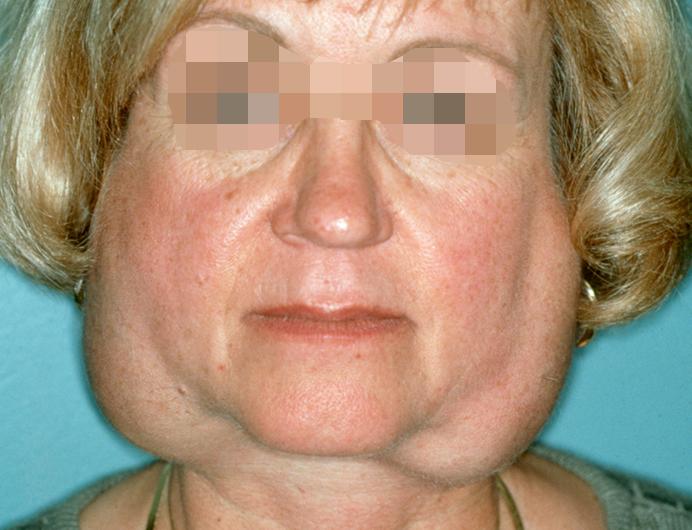
The most common symptoms of Sjogren's syndrome are dry mouth and dry eyes, leading to other related symptoms.
Many women experience vaginal dryness, which makes intercourse painful.
—Associated symptoms of dry mouth.
Associated symptoms of dry mouth include:
- tooth decay, leading to an increased risk of tooth loss;
- dry cough;
- difficulty swallowing and chewing;
- hoarse voice;
- difficulty speaking;
- swollen salivary glands (located between the jaw and ears (photo above))
- Recurrent fungal infections of the mouth (thrush), symptoms include white, cream, or yellow patches on the inside of the mouth and tongue.
—Concomitant symptoms of dry eyes.
Concomitant symptoms of dry eye include:
- burning or tingling in the eyes;
- itchy eyes;
- the feeling that there are particles of sand or debris in the eyes;
- irritated and inflamed eyelids;
- light sensitivity (photophobia)
- tired eyes;
- discharge of mucus from the eyes.
Symptoms may worsen if you are in a windy or smoky environment. Air-conditioned buildings and air travel can also make symptoms worse.
—Other symptoms of Sjogren's syndrome.
In more serious cases of Sjogren's syndrome, the immune system affects other parts of the body, and a wide range of symptoms join the existing problem:
- dry skin;
- chronic fatigue;
- muscle pain;
- joint pain (arthralgia), stiffness and swelling;
- pain and numbness in certain parts of the body, usually in the arms or legs (peripheral neuropathy);
- limited blood flow to the hands, making the hands feel cold, numb, and painful (Raynaud's syndrome);
- vasculitis (inflammation of the blood vessels).
Causes and risk factors
The immune system is designed to recognize any foreign microorganism that poses a threat to the body, such as a virus or bacteria, and special chemicals known as antibodies (produced by leukocytes).
In Sjogren's disease, the immune system mistakes healthy tissues for foreign bodies and attacks them with antibodies. The parts of the body commonly affected are the lacrimal, salivary, and vaginal glands, collectively known as the exocrine glands.
Antibodies damage the exocrine glands so that they can no longer function normally. There is also some evidence that the immune system damages the nerves that control the glands, further reducing their effectiveness.
The immune system can damage other parts of the body (muscles, joints, blood vessels, nerves, and (less commonly) organs).
Possible risk factors
- Primary Sjogren's syndrome.
The exact cause of Sjogren's syndrome is unknown, but most scientists assume that the disease is caused by a combination of genetic and environmental factors.
The general consensus is that certain people are born with certain genes that predispose them to autoimmunity. Then, many years later, an environmental factor (the most likely virus, for example, Epstein-Barr virus or hepatitis C) cause inadequate functioning of the immune system.
The female hormone estrogen also appears to play an important role. The disease is more common in women, and symptoms usually begin around menopause when estrogen levels begin to drop. This may indicate that the decrease in estrogen levels somehow disrupts the normal functioning of the immune system. How exactly this happens is unclear.
- Secondary Sjogren's syndrome.
The secondary form of the disease occurs later in the course of other autoimmune disorders, such as rheumatoid arthritis or systemic lupus erythematosus.
If the person has one of these disorders, the person will be supervised by a specialist who will diagnose Sjogren's syndrome when the patient begins to experience dryness of the eyes and mouth.
The importance of the exocrine glands
The reason Sjogren's disease causes such a wide range of unpleasant symptoms is because the salivary and lacrimal glands play a vital role in protecting the mouth and eyes.
- The importance of tears.
Usually tears are only noticeable when a person is crying. However, the eyes are always covered with a thin layer of tears called a tear film.
Tears are made up of a mixture of water, proteins, fats, mucus, and infection-fighting cells. Tears have several important functions:
- lubricate the eyes, keeping them clean, protecting them from dust;
- protects the eyes from infection;
- helps stabilize vision.
- The importance of saliva.
Saliva also serves several important functions:
- preserves the natural microflora of the mouth and throat;
- promotes digestion by moisturizing food and containing enzymes that break down certain starches;
- acts as a natural disinfectant (saliva contains antibodies, enzymes, and proteins that protect against some common bacterial and fungal infections).
Affected populations
Sjogren's syndrome is a relatively common condition. In Russia, it is believed that 3-4% of adults suffer from it. This makes the disorder the second most common autoimmune disease after rheumatoid arthritis. However, the condition remains underestimated and often insufficiently treated.
Sjogren's disease can develop at any age, but most cases occur in adults between the ages of 40 and 60. 9 out of 10 patients are women.
Diagnostics
Sjogren's syndrome is difficult to diagnose because the symptoms are similar to those of other diseases, including systemic lupus erythematosus, rheumatoid arthritis, fibromyalgia, chronic fatigue syndrome and multiple sclerosis. The side effects of some medications also mimic some of the signs and symptoms of Sjogren's syndrome.
In addition, the patient may see a variety of medical professionals for various symptoms, such as a dentist for dry mouth, an ophthalmologist for dry eyes and a gynecologist for vaginal dryness, which makes it difficult to establish an accurate diagnosis.
A lot of research is done to rule out other conditions and help make an accurate diagnosis.
- Blood tests.
Blood tests are done to look for specific antibodies known as anti-Ro and anti-La (or SS-A and SS-B), which are known to form when a person's immune system is affected by Sjogren's disease.
However, antibodies are only present in about 60% of patients with the disease, so a negative blood test result is possible even if the condition is present.
- Eye examinations.
A doctor can test for dry eyes with a test called the Schirmer test. A small piece of filter paper is placed under the lower eyelid to measure the level of tear production.
A doctor who specializes in treating eye conditions (ophthalmologist) also examines the surface of the eyes with a magnifying device called a slit lamp.
- Lip biopsy.
During a lip biopsy, a small piece of tissue is removed from the inner lip and examined under a microscope. The patient is given local anesthesia on the inner surface of the lower lip, then a small incision is made to remove several small salivary glands.
Clusters of lymphocytes (a type of white blood cell) in the tissues found may indicate the presence of a disease.
- Visualization research methods.
Certain imaging tests will help check the function of the salivary glands.
- Sialogram. This is a special X-ray examination that detects a dye that is injected into the salivary glands in front of the ears. The procedure shows how much saliva is produced in the patient's mouth.
- Scintigraphy of the salivary glands. This is a nuclear medicine study that involves injecting a radioactive isotope into a vein that is monitored for an hour to see how quickly it enters all the salivary glands.
Treatment for Sjogren's syndrome

There is no cure for Sjogren's syndrome. Treatment for the disorder is essentially symptomatic.
Dry eye treatment
- Artificial tears.
Mild to moderate cases of dry eyes are usually successfully treated with eye drops containing artificial tears, a liquid that simulates tears. These eye drops are available from your pharmacist without a prescription.
There are many different types of eye drops, so patients may try different brands to find the one that works best.
Short-term use of eye drops containing corticosteroids is recommended if the eyes are severely irritated. However, long-term use of corticosteroids is not recommended because of its serious side effects, such as Cushing's syndrome, a rare hormonal disorder that causes sudden weight gain.
To minimize the likelihood of side effects of corticosteroids, the patient is given the lowest effective dose for a short time.
- Waterproof glasses.
Some cases of dry eye are treated with specially made glasses known as waterproof goggles. They wrap the eyes, help retain moisture, and protect the eyes from irritants.
Previously, waterproof goggles were unpopular because they had strange designs and patients were embarrassed to wear them. They are now an increasingly popular treatment option as the modern design looks like sports sunglasses.
- Surgical intervention.
If dry eyes do not respond to treatment with drops, surgery may help the patient.
One commonly used technique is punctual occlusion, which involves using small plugs to seal the tear ducts into which tears drain. This should help protect the eyes from dryness.
Temporary plugs made of silicone are usually used first to ensure that the surgery is having a positive impact. In case of a positive effect, the silicone plugs are replaced with more permanent ones.
Dry mouth treatment
Sufferers can use a number of methods to treat dry mouth and associated symptoms:
- maintain oral hygiene to prevent tooth decay and gum disease;
- increase fluid intake;
- Chewing sugar-free gum to stimulate saliva production
- Sucking on ice cubes to help lubricate your mouth and reduce dryness
- rinse your mouth regularly to moisturize your mouth and protect against infections.
If the patient smokes, quit. Smoking irritates the mouth and increases the rate of evaporation of saliva.
There are also a number of saliva substitutes available to help moisturize your mouth. However, they do not duplicate the role of saliva in preventing infection, so good oral hygiene must still be maintained.
Saliva substitutes are available as a spray, lozenge, gel, or chewing gum.
Drug treatment
- Pilocarpine.
Pilocarpine is often used to treat symptoms of dry eyes and mouth. Pilocarpine stimulates the lacrimal and salivary glands.
Side effects of pilocarpine include:
- increased sweating;
- nausea;
- diarrhea;
- heartburn;
- abdominal pain;
- headaches;
- dizziness;
- increased urination.
Less common side effects:
- vomit;
- heart palpitations (tachycardia);
- arterial hypertension;
- blurred vision.
Blurred vision and dizziness can affect the ability to perform skilled tasks such as driving or operating heavy equipment. Avoid such tasks if you experience these side effects.
Some patients experience minor side effects of pilocarpine, others are more severe.
Do not take pilocarpine if you have asthma or chronic obstructive pulmonary disease (COPD), or if pregnant or breastfeeding.
- Hydroxychloroquine.
The drug slows down the attack of the immune system on the lacrimal and salivary glands. Hydroxychloroquine also helps reduce any associated muscle and joint pain symptoms.
You need to take hydroxychloroquine for several weeks before you see noticeable improvements. However, it may take 6 months before the patient feels the full effect of the drug.
Side effects are rare and usually minor:
- headache;
- nausea;
- skin rash;
- itching;
- loss of appetite;
- stomach cramps;
- vomit.
In very rare cases, hydroxychloroquine can damage the retina, affecting vision. Patients are asked to undergo an eye exam to check the condition of the retina before starting treatment. Regular eye examinations (usually at least once a year) are also recommended after starting treatment.
Hydroxychloroquine should not be taken by pregnant or lactating women.
Treating other symptoms of Sjogren's syndrome
Dry skin use soaps and creams specially designed for people with dry skin.
Vaginal dryness symptoms can be treated with lubricants. Some women are considering using estrogen creams or hormone replacement therapy.
Muscle and joint pain are treated with over-the-counter non-steroidal anti-inflammatory drugs (NSAIDs) such as ibuprofen. If ibuprofen doesn't work, see your doctor, as some of the stronger NSAIDs are available with a prescription.
NSAIDs may increase the risk of developing stomach ulcers and internal bleeding, especially if taken for a long time. Ideally, NSAIDs are taken with or shortly after meals. This helps to minimize the risk of indigestion.
If it is difficult to swallow NSAID tablets due to dry mouth, you can try NSAID cream that is rubbed into the affected joints.
NSAIDs are not recommended for women who are pregnant or lactating, or for those with pre-existing risk factors for cardiovascular disease or kidney disease.
Forecast
Sjogren's syndrome can cause significant damage to vital organs. However, some patients experience a milder form of pathology limited to dry eyes and mouth. In other cases, the disease can lead to serious complications.
- Non-Hodgkin's lymphoma.
It is estimated that people with Sjogren's disease are 44 times more likely to develop non-Hodgkin's lymphoma than people without the syndrome.
Non-Hodgkin's lymphoma - cancer of the lymphatic system. The lymphatic system is a series of vessels and glands (lymph nodes) that extend through the body, much like blood vessels.
While this increased risk may seem alarming, the likelihood that a person with Sjogren's disease will develop non-Hodgkin's lymphoma is still unlikely and affects about 5% of patients.
If you have Sjogren's disease, look for the main early symptom of non-Hodgkin's lymphoma. characterized by painless swelling in a lymph node (gland), usually in the neck, armpit or groin. Report any swollen lymph nodes to your doctor.
- Eye damage.
If left untreated, dry eyes can lead to infections and ulcers on the surface of the eyes called corneal ulcers.
If left untreated, corneal ulcers result in loss and damage to vision.
- Pregnancy.
If a woman plans to become pregnant with Sjogren's syndrome, ask the doctor to check for antibodies present in the disease, as these antibodies are known to cause lupus in newborns. In very rare cases, antibodies cause heart defects in children.
If antibodies are found, there is no reason why the woman cannot continue the pregnancy, but the baby may need additional specialist help during pregnancy and after delivery.


